

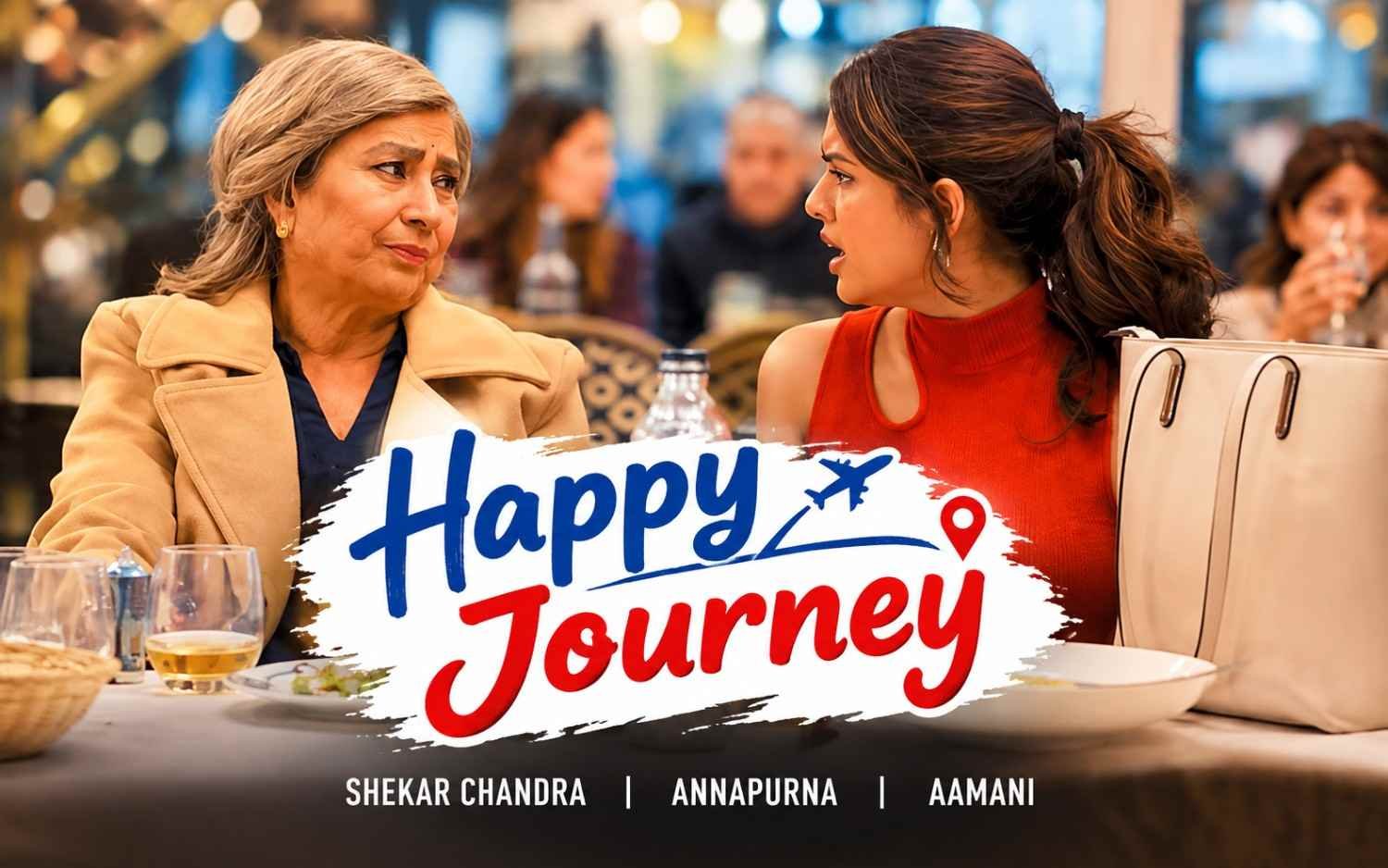
Happy Journey – Telugu | Shekar Chandra | Annapurna | Aamani
Movie Details
| Category | Details |
|---|---|
| Movie Name | Happy Journey |
| Director | Abhiramm Naidu |
| Lead & Supporting Cast | Annapurnamma, Aamani, Jhansi, Payal Radhakrishna, Jinisha Alishetty, Roopa Srinivas, Sunaina, Prudhvi Dandamudi, Vamshidhar Goud, Ravi Siva Teja Paila |
| Genre | Adventure, Drama, Comedy, Emotional Road Movie |
| Language | Telugu |
| Release Date | 18 September 2026 |
| OTT Platform | Not officially announced |
| Music | Shekar Chandra |
| Cinematography | Manikandan Subramaniyan |
| Editing | Chota K. Prasad |
| Production Design | Brahma Kadali |
| Rating | 3.75/5 Stars |
Happy Journey – Telugu | Shekar Chandra | Annapurna | Aamani
Introduction & Overview
Happy Journey – Telugu | Shekar Chandra | Annapurna | Aamani is a refreshing Telugu film that places women at the centre of a story about travel, friendship, emotions and rediscovering life. Directed by Abhiramm Naidu, the film brings together seven prominent female performers — Annapurnamma, Aamani, Jhansi, Payal Radhakrishna, Jinisha Alishetty, Roopa Srinivas and Sunaina — for a narrative that moves away from the conventional hero-centric commercial format.
The film is scheduled to release in theatres on 18 September 2026 and has created interest because of its unusual ensemble structure. Rather than presenting one central protagonist, the movie gives importance to several women, each carrying her own experiences, emotions and personal struggles. Their lives eventually intersect during a journey that becomes much more meaningful than an ordinary holiday.
The title Happy Journey initially sounds simple, but the film uses travelling as a metaphor for change, healing and self-discovery. The result appears to be a warm emotional drama with comedy, adventure and a strong human element.
Detailed Plot Summary
At its heart, Happy Journey follows seven women who embark on a trip expecting to enjoy a holiday and temporarily escape the routines and pressures of everyday life. However, the journey gradually becomes much more significant than they originally anticipated.
The seven central characters come from different backgrounds and carry their own emotional histories. Their personalities, experiences and expectations are not identical, which gives the group dynamic an interesting foundation. Initially, they may simply be people sharing the same journey, but as they spend more time together, personal boundaries begin to disappear.
Travel creates an unusual environment for people to open up. Away from their familiar surroundings, responsibilities and social expectations, the women are able to speak more freely and confront feelings that may have remained hidden for years. Conversations, disagreements, laughter and shared experiences slowly create a bond between them.
The movie’s central idea is that a journey does not always have to be about reaching a destination. Sometimes the journey itself becomes an opportunity to understand who we are and what we truly want from life.
The story reportedly moves through picturesque international locations, including parts of Europe, while maintaining an emotional connection to the characters. The beautiful surroundings are therefore more than simple visual attractions. They become part of the transformation taking place within the group.
As the journey progresses, friendships develop and strangers begin to feel like family. The characters discover that their individual problems are not as isolating as they once believed. Shared experiences allow them to see their lives from new perspectives.
The supporting characters, including Prudhvi Dandamudi, Vamshidhar Goud and Ravi Siva Teja Paila, add another layer to the narrative without taking away from the women’s central journey.
Importantly, Happy Journey does not appear to depend on a conventional villain or a high-stakes external conflict. Its real focus is emotional — relationships, memories, disappointments, dreams and the courage to start looking at life differently.
The film therefore promises an uplifting narrative in which travel becomes a catalyst for personal transformation. Rather than revealing major developments, the story allows audiences to discover the characters’ emotional journeys gradually.
Cast Performances & Character Breakdown
Annapurnamma
Annapurnamma is one of the most experienced performers in the ensemble and brings considerable emotional credibility to the film. Her presence is particularly valuable in a story that depends heavily on relationships and conversations.
She represents an older generation within the group, allowing the film to explore how experiences accumulated over decades can influence the way a person looks at family, friendship and personal happiness. Her natural screen presence should help make the emotional portions feel grounded rather than overly dramatic.
Annapurnamma’s performance is likely to be one of the film’s strongest emotional anchors.
Aamani
Aamani is another major attraction. Known for her ability to portray warmth and emotional depth, she fits naturally into a story that places mature relationships at the centre.
Her character appears to contribute to the film’s exploration of personal identity and life choices. Aamani’s ability to communicate emotion through subtle expressions can be particularly effective in quieter scenes.
Her interactions with the other women should also be important to establishing the sense of friendship that drives the journey.
Jhansi
Jhansi adds a different energy to the ensemble. Her presence helps broaden the personalities within the group and creates opportunities for lighter as well as more serious moments.
In a multi-character film, performers such as Jhansi are essential because they help prevent the group from feeling like a collection of similar personalities. Her character can contribute humour, spontaneity and emotional contrast.
Payal Radhakrishna
Payal Radhakrishna represents a younger perspective within the ensemble. Her participation gives the film an opportunity to explore how younger women approach relationships, aspirations and personal freedom.
Her performance will be important in connecting the movie with younger viewers while maintaining the broader emotional appeal of the story.
Jinisha Alishetty
Jinisha Alishetty is another member of the seven-woman ensemble. Her character adds another individual perspective to the central journey.
The strength of her role will depend on how effectively the screenplay gives each woman a distinctive emotional identity. If handled well, Jinisha’s character can contribute significantly to the film’s larger message about friendship and self-discovery.
Roopa Srinivas
Roopa Srinivas brings another layer to the ensemble. Her character forms part of the collective emotional journey and helps demonstrate that the film is not about one individual’s transformation but about several lives changing through shared experiences.
Her screen presence contributes to the diversity of personalities within the group.
Sunaina
Sunaina completes the principal seven-woman ensemble. Her character provides another perspective on the journey and its emotional consequences.
The film’s success depends significantly on the chemistry between these seven performers. Rather than competing for attention, they need to make their characters feel like members of a believable group. The available premise suggests that friendship and camaraderie are central to the movie, making ensemble chemistry particularly important.
Supporting Cast
Prudhvi Dandamudi, Vamshidhar Goud and Ravi Siva Teja Paila appear in important supporting roles. Their presence provides additional narrative dimensions without shifting the focus away from the seven women.
Prudhvi Dandamudi can bring emotional seriousness to the story, while Vamshidhar Goud and Ravi Siva Teja Paila contribute to the wider world surrounding the protagonists.
The supporting cast ultimately works best if it complements the women’s stories rather than overshadowing them.
Direction, Screenplay & Technical Aspects
Abhiramm Naidu’s Direction
Abhiramm Naidu makes his directorial debut with Happy Journey, taking on the challenge of handling a large female ensemble.
The most interesting aspect of his direction is the decision to structure the story around seven women instead of relying on a single central protagonist. This gives the film a broader emotional canvas and creates opportunities to explore different stages of life, personalities and perspectives.
The director’s biggest challenge is maintaining balance. Every character needs enough development, while the overall story must continue moving forward.
Screenplay
The screenplay appears to combine road-trip adventure with emotional drama and light-hearted comedy. This combination can work extremely well when the characters remain at the centre of the narrative.
The travelling structure naturally creates opportunities for unexpected conversations, humorous situations, disagreements and emotional revelations. The screenplay can therefore use the changing locations as a way of reflecting the characters’ changing emotional states.
Cinematography
Manikandan Subramaniyan handles cinematography, and the international locations provide an attractive visual canvas.
With the story travelling through scenic European settings, the cinematography has the opportunity to capture both the grandeur of the locations and the intimacy of the characters. The best road-trip films make their landscapes feel like part of the storytelling, and Happy Journey appears to follow that approach.
Editing
Chota K. Prasad handles the editing. Editing is particularly important for an ensemble road movie because multiple characters and locations can easily make the narrative feel fragmented.
A smooth rhythm between individual stories, group conversations and travel sequences will be essential to maintaining audience engagement.
Music and Background Score
Shekar Chandra provides the music. His contribution should complement the film’s emotional and travel-oriented atmosphere.
Music can play a major role in a movie such as this because songs and background themes can connect different locations and emotional phases. A well-designed soundtrack can also reinforce the film’s central message of enjoying life, friendship and personal renewal.
Strengths & Weaknesses / Pros & Cons
Pros
- Seven women at the centre: The female-led ensemble is one of the film’s biggest distinguishing features.
- Strong veteran presence: Annapurnamma and Aamani bring maturity and emotional credibility to the story.
- Fresh road-trip concept: The travel structure provides a natural setting for friendship, humour and emotional transformation.
- Beautiful locations: The international backdrop gives the film visual appeal while supporting its journey-based theme.
- Strong music team: Shekar Chandra’s music should complement the emotional and feel-good nature of the story.
- Positive emotional message: The film focuses on friendship, rediscovery, hope and finding new meaning in life.
Cons
- Multiple protagonists: Giving seven central characters sufficient development could be difficult.
- Possible uneven pacing: A story involving several individual journeys may occasionally feel episodic.
- Genre balance: The movie needs to successfully combine comedy, drama, adventure and emotional storytelling.
- Character depth: If some characters receive less development than others, the ensemble structure could lose some of its potential impact.
Final Verdict & Target Audience
Happy Journey – Telugu | Shekar Chandra | Annapurna | Aamani looks like a warm and emotionally driven Telugu road-trip film that aims to celebrate friendship, travel and the possibility of beginning again.
Its seven-woman central cast gives it a distinctive identity, while the combination of Annapurnamma, Aamani, Jhansi, Payal Radhakrishna, Jinisha Alishetty, Roopa Srinivas and Sunaina creates considerable curiosity.
The film should appeal to viewers who enjoy emotional dramas, female-centric stories, friendship narratives, travel films and feel-good Telugu cinema.
With its theatrical release on 18 September 2026, it could be a good choice for audiences looking for something lighter and more emotionally focused than conventional commercial cinema.