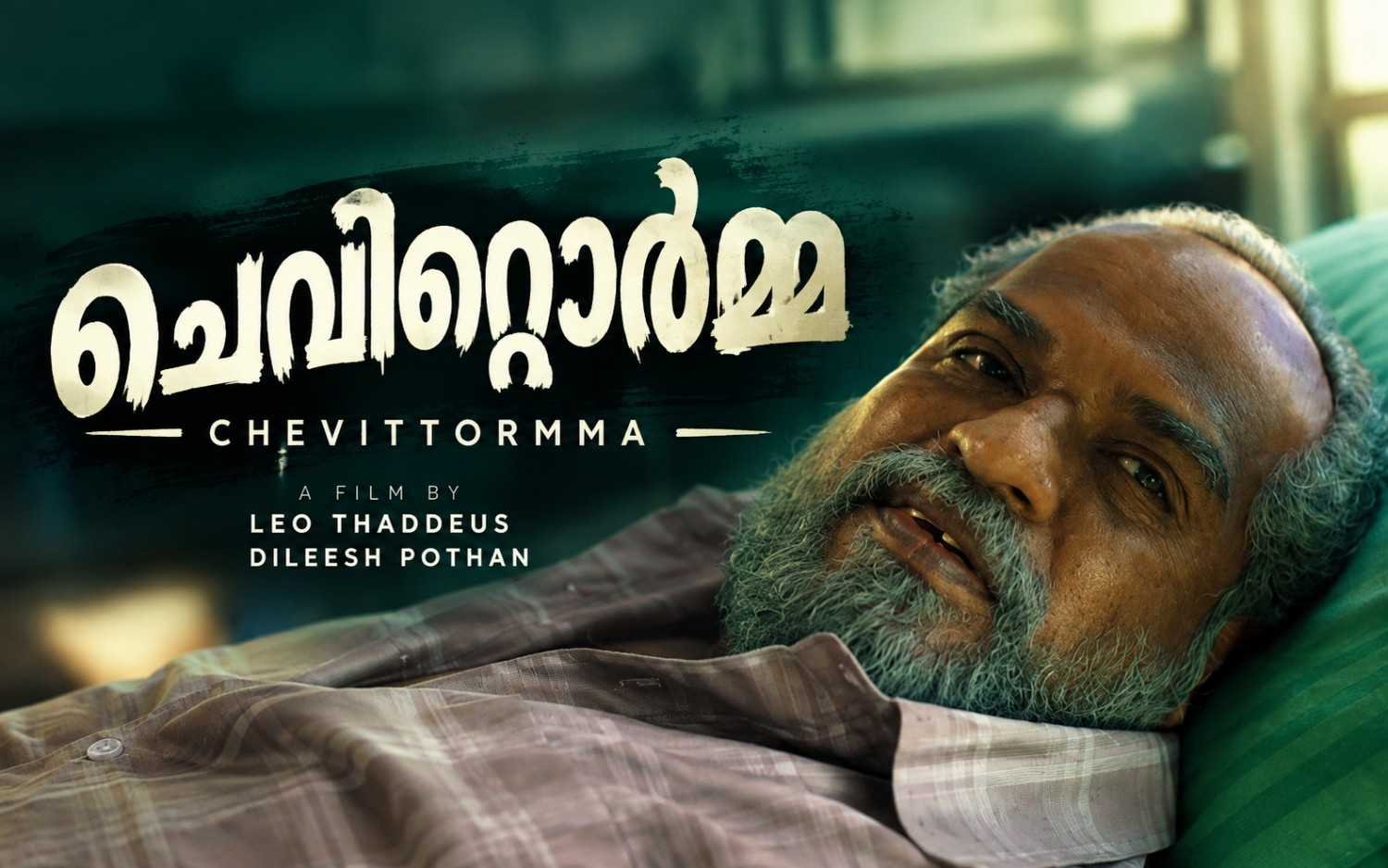
CHEVITTORMMA – Malayalam | LEO THADDEUS I DILEESH POTHAN
Movie Details
| Movie Details | Information |
|---|---|
| Movie Name | CHEVITTORMMA (The Soul Whisperer) |
| Director | Leo Thaddeus |
| Writer | Leo Thaddeus |
| Lead Cast | Dileesh Pothan, Pauly Valsan |
| Supporting Cast | George Kora, Haritha Parakkode, Sreekanth Murali, Jeo Baby, Parvathy Arun |
| Genre | Meditative Family Drama / Emotional Drama |
| Language | Malayalam |
| Runtime | Approximately 93–95 minutes |
| World Premiere | Busan International Film Festival, October 2026 |
| Theatrical Release | Not officially announced |
| OTT Platform | Not officially announced |
| Rating | 4/5 Stars |
Introduction & Overview
CHEVITTORMMA – Malayalam | LEO THADDEUS I DILEESH POTHAN is a quietly ambitious Malayalam film that explores mortality, human relationships, emotional attachment and the difficult process of letting go. Written and directed by Leo Thaddeus, the film brings together two distinctive performers, Dileesh Pothan and Pauly Valsan, in a story that appears deliberately intimate rather than conventionally commercial.
The English title, The Soul Whisperer, offers an important clue about the film’s emotional direction. Rather than presenting death simply as an ending, the movie approaches the final stage of life as a deeply human experience involving memories, relationships, unfinished emotions and spiritual questions.
The film has also attracted international attention with its selection for the Busan International Film Festival, where it is scheduled to have its world premiere in the A Window on Asian Cinema section. This gives the project an additional artistic dimension and places it within a broader international festival context.
From the trailer, CHEVITTORMMA appears to favour silence, atmosphere and performance over spectacle. Its strength seems to lie in the emotional questions it raises rather than in conventional plot twists.
Detailed Plot Summary
At the heart of CHEVITTORMMA is Theresia, a woman whose unusual role involves visiting people who are approaching the end of their lives. She offers final prayers to those lying on their deathbeds, attempting to help them release their emotional and spiritual attachments and move peacefully toward death.
This unusual responsibility places Theresia in situations where she encounters people at their most vulnerable. Death may be a universal experience, but every individual approaches it differently. Some may be prepared to let go, while others remain attached to memories, relationships, regrets or unresolved conflicts.
The story takes a significant turn when Theresia becomes connected with Payyammal Varkichan, an influential and powerful man portrayed by Dileesh Pothan. Their meeting forms the central dramatic premise of the film.
What begins as a situation surrounding death gradually develops into something more emotionally complex. The relationship between Theresia and Varkichan allows the screenplay to examine the difference between simply waiting for death and actually confronting everything that remains unresolved before death arrives.
The narrative does not appear interested in treating mortality as something frightening in a conventional cinematic sense. Instead, it explores the psychological and emotional space surrounding a person’s final moments.
The title Chevittormma itself evokes the idea of memory and listening, while The Soul Whisperer suggests a person who communicates with the emotional and spiritual side of those approaching their final moments.
The story also appears to examine how a person’s past continues to influence the present. Old memories, unresolved relationships and hidden emotional wounds can remain powerful even when physical life is approaching its conclusion.
Importantly, the film’s appeal seems to come from what it leaves unsaid. Rather than revealing every emotional layer immediately, Leo Thaddeus appears to allow the characters and their interactions to gradually expose the deeper meaning of the story.
Avoiding major revelations is essential with a film like this because its emotional impact depends on experiencing the characters’ journey rather than simply knowing the events beforehand.
Cast Performances & Character Breakdown
Dileesh Pothan as Payyammal Varkichan
Dileesh Pothan plays Payyammal Varkichan, one of the film’s central characters. His casting is particularly appropriate for a story that requires subtle emotional acting.
Pothan has consistently demonstrated an ability to make complicated characters feel authentic without relying on exaggerated performances. In CHEVITTORMMA, that quality becomes even more important because Varkichan appears to be a character whose personality is shaped by power, experience and emotional history.
The character’s relationship with mortality creates an opportunity for Pothan to explore quieter shades of performance. Instead of depending on dramatic monologues or highly theatrical reactions, the role appears to demand expressions, pauses and silences that communicate what the character cannot easily say.
The contrast between Varkichan’s outward status and his inner emotional world is potentially one of the film’s most interesting elements.
Pauly Valsan as Theresia
Pauly Valsan takes on the role of Theresia, the woman who helps people during their final moments. This is a demanding character because Theresia must be simultaneously compassionate, spiritually grounded and emotionally strong.
Her profession places her close to death on a regular basis, yet the film does not appear to present her as someone who has become emotionally detached. Instead, her encounters with dying people seem to force her to repeatedly confront questions about life, relationships and the meaning of letting go.
Pauly Valsan’s naturalistic acting style suits the role particularly well. The character requires restraint, warmth and an ability to communicate emotion through small gestures.
The dynamic between Theresia and Varkichan is likely to become the emotional centre of the film.
George Kora
George Kora is part of the supporting ensemble and contributes to the film’s wider character landscape. In a story built around intimate relationships, supporting characters have an important function because they provide different perspectives on the central emotional conflict.
His presence adds depth to the world surrounding Theresia and Varkichan and helps prevent the narrative from becoming a simple two-character chamber drama.
Haritha Parakkode
Haritha Parakkode is also part of the supporting cast. Her contribution adds another layer to the film’s exploration of relationships and emotional memory.
A film dealing with mortality needs believable human connections around its central characters, and supporting performers such as Haritha help create that wider emotional environment.
Sreekanth Murali
Sreekanth Murali brings additional experience to the ensemble. His presence strengthens the film’s grounded Malayalam cinema aesthetic.
The supporting performances are especially important because CHEVITTORMMA appears to derive much of its realism from ordinary people placed in extraordinary emotional circumstances.
Jeo Baby and Parvathy Arun
Jeo Baby and Parvathy Arun are also associated with the film’s cast. Their participation expands the ensemble and contributes to the film’s exploration of family, memory and human relationships.
Rather than functioning as conventional supporting figures whose sole purpose is to advance the plot, the supporting characters appear to belong naturally to the emotional world created by Leo Thaddeus.
Direction, Screenplay & Technical Aspects
Leo Thaddeus’ Direction
Leo Thaddeus writes and directs CHEVITTORMMA, continuing his interest in character-driven Malayalam storytelling. His earlier work has explored different facets of ordinary life, relationships and human behaviour, and this film appears to take that approach into more contemplative territory.
The biggest strength of the direction is its apparent willingness to slow down. In an era where many films attempt to maintain constant momentum, CHEVITTORMMA seems comfortable allowing silence and observation to become part of the storytelling.
Screenplay
The screenplay is built around a simple but emotionally rich premise: a woman who helps people prepare for death encounters a powerful man whose own relationship with mortality becomes increasingly significant.
That setup creates opportunities to explore memory, regret, forgiveness, attachment and acceptance without turning the film into a conventional melodrama.
The screenplay’s success will depend on how naturally these themes emerge through character interactions. Based on the trailer, the film appears to favour emotional discovery over exposition.
Cinematography
Swaroop Shobha Shankar handles cinematography. The visual approach appears restrained and atmospheric, complementing the film’s meditative tone.
Instead of overwhelming the audience with elaborate visuals, the cinematography seems designed to observe characters and environments carefully. This is appropriate for a story where small details can carry substantial emotional meaning.
Editing
Internationally recognised editor Carlo Francisco Manatad handles the editing. For a film of this nature, editing needs to preserve the rhythm of silence and conversation without allowing the narrative to become unnecessarily slow.
A measured editing style can strengthen emotional scenes by allowing performances to breathe.
Music and Sound
Milad Movahedi handles the music, while the film also features an international technical collaboration in sound and post-production.
Music in a contemplative drama should support emotion rather than manipulate it. The ideal approach is one where the score quietly enhances the atmosphere while allowing dialogue, silence and natural sounds to remain important.
Strengths & Weaknesses / Pros & Cons
Pros
- Powerful central concept: The idea of helping people achieve peace during their final moments offers plenty of emotional and philosophical depth.
- Strong lead pairing: Dileesh Pothan and Pauly Valsan bring considerable acting credibility to the central relationship.
- Thought-provoking themes: Mortality, memory, forgiveness, attachment and letting go give the film substance beyond its basic plot.
- International festival appeal: Its selection for Busan adds considerable prestige and curiosity.
- Restrained filmmaking: The meditative approach should appeal to audiences who prefer character-driven cinema.
- Strong technical team: The cinematography, editing, music and sound design come together to support the film’s intimate atmosphere.
Cons
- Slow pacing may not suit everyone: Viewers expecting a conventional commercial Malayalam drama may find the film deliberately quiet.
- Emotion-driven storytelling: The movie appears to prioritise character and atmosphere over conventional plot mechanics.
- Limited mass appeal: Its contemplative approach may appeal more strongly to festival audiences and viewers interested in serious cinema.
- Minimal spectacle: Audiences looking for comedy, action or conventional entertainment may not find those elements central to the experience.
Final Verdict & Target Audience
CHEVITTORMMA – Malayalam | LEO THADDEUS I DILEESH POTHAN looks like an intimate and thoughtful Malayalam drama built around one of life’s most universal experiences: the process of letting go.
With Dileesh Pothan and Pauly Valsan leading the cast, Leo Thaddeus appears to have created a film that values performances, atmosphere and emotional honesty over commercial spectacle. Its Busan selection further strengthens expectations around its artistic qualities.
The film should appeal particularly to viewers who enjoy slow-burn Malayalam dramas, festival cinema, character-driven stories and emotionally reflective films. It is best approached with patience rather than expectations of conventional entertainment.
For audiences interested in thoughtful cinema that explores life and death through human relationships, CHEVITTORMMA looks like a film worth watching, especially on the festival circuit and, once announced, through its eventual theatrical or OTT release.